
Look Wild: Meadow habitats of the Yorkshire Dales
-
Date posted: 28/07/2022
-
Time to read: 10 minutes
Yorkshire Dales National Park is home to special habitats for wildflowers, from the moist and shaded conditions provided by extensive limestone pavement to the spectacle of fragrant meadows teeming with up to 120 species produced by traditional, low intensity management of grazing land over many decades. It is the perfect place for novices and specialists alike to spot and record a wide variety of flora.
The NPUK Look Wild project encourages anyone out and about in the UK’s National Parks to use the iNaturalist app to discover and record the natural world around them. In the Yorkshire Dales we think we have just the thing to get you started.
At this time of year our beautiful hay meadows are at their ‘midsummer best’. It’s no wonder National Meadows Day celebrates these stunning environments each July. Hay meadows are an iconic feature of the English countryside and are of great agricultural importance, providing farmers with food for their livestock during the winter months, as well as ecological importance, providing a home for grassland plants and a source of nectar for a wide range of pollinator species.
Yorkshire Dales National Park contains a large proportion of the UK’s upland hay meadows, a priority habitat for nature conservation. These are now very scarce nationally with just 870 hectares surviving in England, and the Yorkshire Dales is one of the few areas where they survive in any number. Every year from early summer, visitors to Langstrothdale, Ribblesdale, Swaledale and Arkengarthdale will find upland hay meadows, surrounded by ancient drystone walls, brimming with colourful wildflowers. Those using the iNaturalist app in the meadows will likely find a large number of plant species, including sweet vernal-grass, wood crane’s-bill, pignut, great burnet and lady’s mantle. Hay meadows also support invertebrates, bats, mammals and birds.
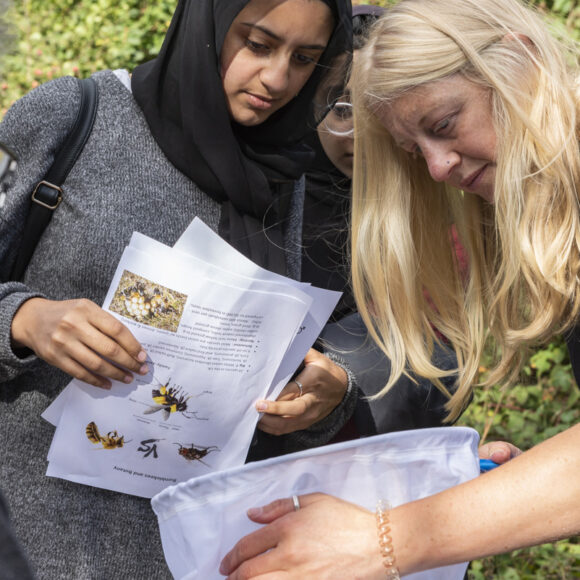
Photo: Our Youth Volunteering Officer Caroline undertaking a bee survey with a pupil. Hay meadows are a vital habitat for many species of bumblebee.
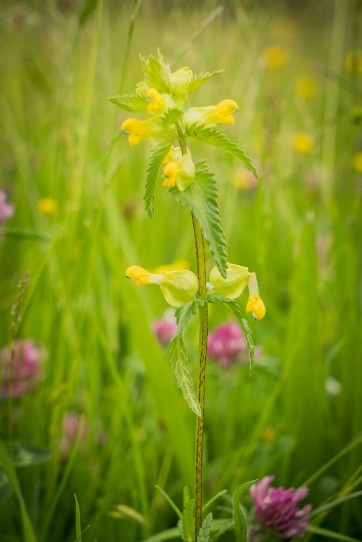
Yellow rattle
Yellow rattle (Rhinanthus minor Family: Scrophulariaceae ) gets its name from its bright yellow flowers and the sound of the ripe seed rattling inside its seed capsules. This annual plant is unusual in that it is semi-parasitic and gains part of its water and nutrient requirements by parasitizing the roots of grasses and other herbs. This characteristic has made it a useful plant in hay meadow restoration projects, where it reduces the domination of vigorous grasses and herbs, such as perennial-rye grass and white clover, enabling other wild flowers to become established.
Sometimes known as hay rattle, this plant is common in species-rich hay meadows in the Yorkshire Dales National Park, such as those in Ribblesdale, Garsdale, Dentdale, Upper Wharfedale, Wensleydale, Swaledale and Arkengarthdale. As an annual plant, its survival depends upon the seeds being shed before the grass is cut for fodder. Therefore, the best time to see it in the Yorkshire Dales is late June and early July.
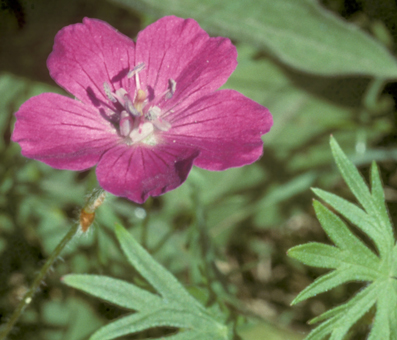
Bloody crane’s-bill
Bloody crane’s-bill (Geranium sanguineum Family Geraniaceae) is characteristic of Yorkshire and Derbyshire’s limestone areas. It has vivid pink flowers, intricately divided leaves and a distinctive red stalk joint which gives the plant its name. Within the British Isles, this species has a localised distribution on grassland, rocky areas, sand dunes and open woods on calcareous soils in northern and western areas.
In the Yorkshire Dales National Park, bloody crane’s-bill flowers between July and August and grows in limestone woodland, on scar ledges and on limestone pavement. Though it isn’t a common plant, good examples of bloody crane’s-bill can be seen in the open rocky parts of Grass Wood near Grassington and on the limestone pavement in the Ingleborough area of Ribblesdale.
If having to really search for plants is more your thing, then the deep grikes of the limestone pavement found in the uplands around Ingleborough, Malham and Wharfedale offer just that. The moist and shaded conditions of these crevices allow ferns and woodland plants to flourish. Using your iNaturalist app, here you are likely to find dog’s mercury, ramsons, hart’s-tongue fern, maidenhair spleenwort, wood anemone, wood sorrel, sanicle and enchanter’s nightshade. Less common are herb paris, angular Solomon’s seal and lily-of-the-valley.

Check out the YDNPA Look Wild page for more about the project and the app. If you’ve been inspired to get out into nature, you can share any photos or observations with us and get featured on our social or our newsletter! Send your observations to connect@nationalparks.uk
LookWild is a brilliant citizen science project that helps contribute to our data and knowledge of wildlife and habitat health across the UK.
This Blog was written by Sally Robertshaw, Volunteers Development Officer, Yorkshire Dales National Park Authority.
Join i-Naturalist and start identifying nature near you today!
Good news for nature August roundup 🌿
This time there’s cats, bugs and birds. There’s so many spectacular sightings, breakthroughs and results for wildlife every single day in our National Parks.
Here are just four pieces of recent good news to make you smile this weekend. Share with someone who loves nature to spread the positivity 💚
#GoodNews #NationalParks #Wildlife


Three years ago, beavers returned to the Cairngorms. 🦫
After more than 400 years away, the first beaver family was released into the National Park in December 2023.
Since then, something special has happened: they’ve settled, spread and started breeding. There are now around 72 beavers in the Cairngorms, including kits born in the wild.
And they’re not just living in the landscape, they’re helping to shape it. By creating wetlands and changing waterways, beavers can help hold and slow water, and create habitats that benefit a whole host of other species. 🌿
It’s a brilliant example of how our National Parks can play a vital role in nature recovery - and what’s possible when people work together to bring species back and create healthier, more resilient landscapes for people and nature.
#NationalParks #Cairngorms #Beavers #NatureRecovery

September is a great time to try nature journaling 📝🍂
A simple form of mindfulness, nature journaling encourages us to slow down and notice what’s happening in the world around us - from the first changing leaves and fungi appearing to the birds we hear and the changing light.
It doesn’t have to be complicated. It’s simply about taking a moment to be present, pay attention and connect with nature.
All you need is a notebook, a pen and somewhere outdoors. Our National Parks are pretty good spots for it, too. 👀
Have you ever tried nature journaling? It’s another way our National Parks are helping people to unwind, everyday.
#NatureJournaling #NationalParks #Mindfulness

🦇When the sun goes down, a whole new world comes to life.
Our National Parks are home to many rare species, including wildlife that can be much harder to spot. The New Forest is home to 14 of the UK’s 18 species of bat, from tiny pipistrelles to some of our rarer woodland species.
Bats depend on a mosaic of habitats to survive, and across the UK’s 15 National Parks, work is happening to protect the places wildlife depends on – even when we don’t always see it.
This International Bat Night, meet just some of the bats our Parks are home to.
📸
1. Soprano Pipistrelle – Russell Wynn / Wild New Forest
2. Soprano Pipistrelle – New Forest National Park
3. Barbastelle – Hugh Clark/Bat Conservation Trust
#BatsOfInstagram #NewForest #InternationalBatNight

15 National Parks. Countless landscapes and communities.💚
Working farmland. Wild coastlines. Woodland paths. Places shaped by generations of people.
Our National Parks are incredibly diverse and not just in the landscapes they protect, but in the people, nature, heritage and stories that make each one unique.
#NationalParksUK #UKNature

Look a little closer and you’ll find a landscape full of life at the Peak District National Park. 🌿
From dippers, ring ouzels and mountain hares in the uplands, to curlews calling across the moorlands and meadow brown butterflies in grasslands, these are just five of the many species you can see in the Peak District this season.
Protecting the special landscapes across our 15 National Padks means protecting the variety of wildlife relying on these habitats as their homes.
Which would you most like to spot? 👀
📷
1. Mountain Hare
2. Curlew
3. Ring Ouzel
4. Meadow Brown Butterfly - Alex Hyde
5. Dipper - Tom Marshall
#PeakDistrict #Wildlife #NationalParksUK

💧It’s World Water Week, and water connects our National Parks in more ways than we might realise.
We know our Parks are full of many beautiful waterscapes, but they’re not just spectacular views.
Water environments offer many hidden benefits to our landscapes, including supporting ecosystems, climate resilience and communities.
Swipe to discover just some of the ways water matters.🌿
Do any of them surprise you?
#NationalParks #WorldWaterWeek #Nature #Biodiversity

💭You might have heard of biodiversity, but what does it actually mean?
It’s the variety of life around us from plants and insects in a meadow to birds, mammals, fungi and the tiny organisms we can’t even see.
But it’s not just a list of species - it’s the intricate web of relationships between them, and our National Parks are home to an incredible diversity of life.
Protecting biodiversity means protecting that web of life.
📸 An adder in @southdownsnp by Simon Watkins.🐍
#Biodiversity #NatureLovers
