Look Wild: Winter Tree ID
-
Date posted: 20/12/2023
-
Time to read: 5 minutes
Dartmoor is known for its wild open moors and granite tors. But one of my favourite features of the moor are the wooded valleys snaking down through the National Park. These woods are rich in wildlife and known as temperate rainforests cloaked in lichens and mosses and drenched by rain and high humidity from the Atlantic. They can be found around Devon and Cornwall, across Wales, the Lake District and into western Scotland. During the Spring they are alive with migrant birds such as the pied flycatcher and redstart which have travelled thousands of miles from west Africa to breed.
The woods are dominated by sessile oak a magnificent tree, producing sessile (or stalkless acorns) and lobed leaves which are stalked. But can you spot a sessile oak in the winter- now that the frosts, wind and rain have taken their toll and stripped them bare of their leaves?
This is a great time to look more closely at the trees and run your hands over the gnarly and pitted bark. Look at the twigs and you’ll see that next years leaves are already tightly packed into winter buds clustered in neat arrangements. With a bit of detective work you will soon be able to tell which twig is from which tree.
Sessile Oak
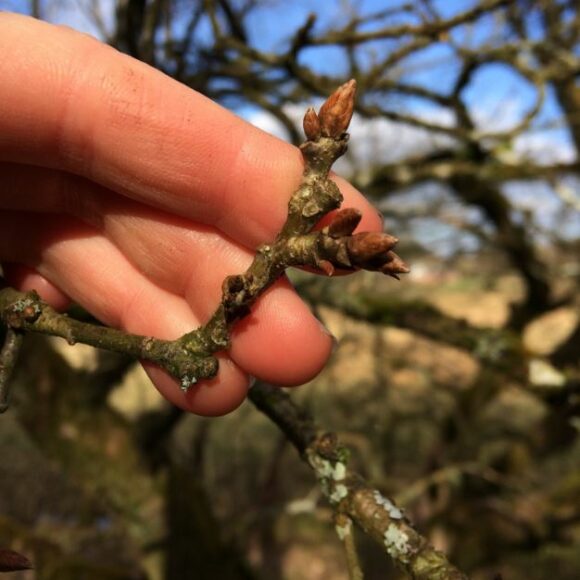
Starting with sessile oaks, look for clusters of leaf buds at the end of the twig and the leaf buds which are covered with many overlapping scales. Look on the floor for fallen leaves which have a stalk and if you are lucky you may find stalkless acorns too.
Ash Tree
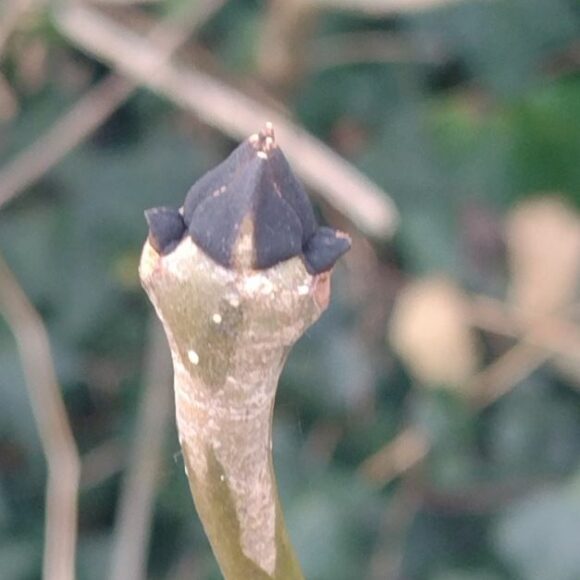
If you find this tricky to identify then the ash tree can be an easier tree to look out for. It has straight grey twigs with a big black bishops hat of a bud at the end and two smaller black buds either side. You might also spot its bunches of keys dangling from the branches – these are the seeds of the tree waiting to drop down. Sadly many ash trees are dying from the ash die back fungal disease so always approach them with caution.
Rowan
Another common tree that you might see is the Rowan, also known as the mountain ash. It is a much smaller tree usually growing to a few metres (but can grow up to 15 metres tall). Its orangey red berries are quickly picked off by the birds, who helpfully transport these seeds and deposit them in new locations around the woods.
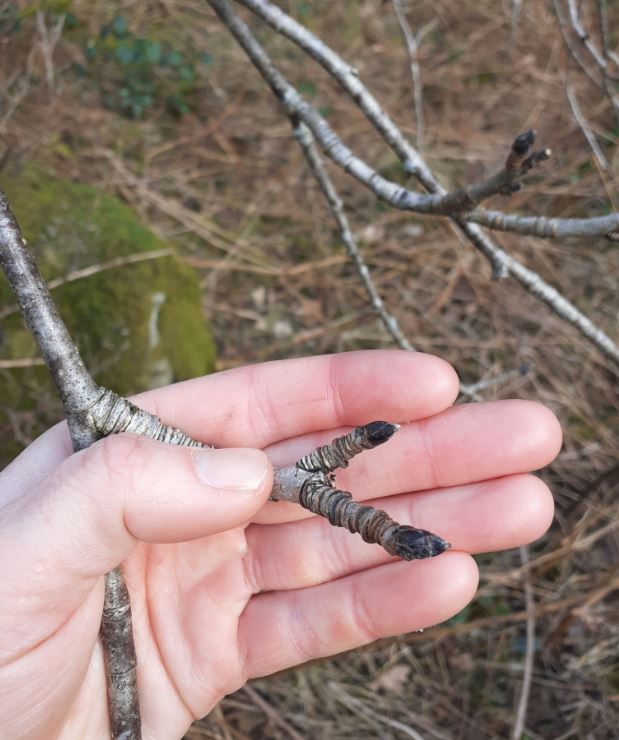
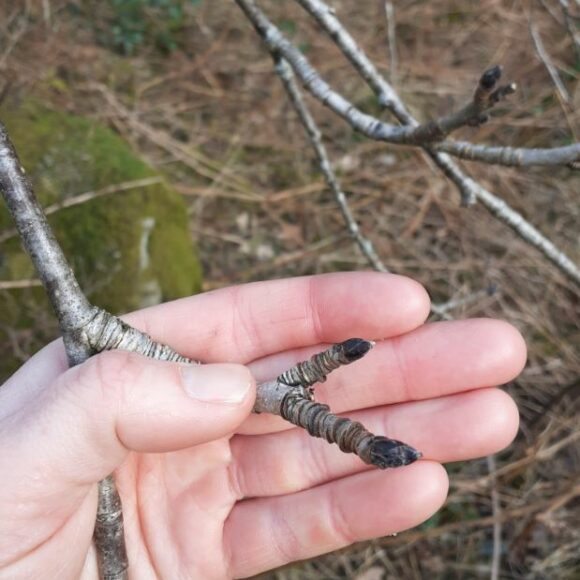
The winter twig has hairy buds with buds alternating either side along the stem of the twig.
Once you start looking at just how different each tree’s buds are you may never look at trees in the same way again. And don’t forget you can always take a picture of the twig and send it to i-naturalist and the app will help you identify it. There are lots of great woodlands to explore on Dartmoor. A great place to start is East Dartmoor National Nature Reserve. Happy twig twitching!
If you’ve been inspired to get out into nature, you can share any photos or observations with us and get featured on our social or our newsletter! Send your observations to connect@nationalparks.uk
Join iNaturalist and start identifying nature near you today! LookWild is a brilliant citizen science project that helps contribute to our data and knowledge of wildlife and habitat health across the UK.
This Blog was written by Andy Bailey at Dartmoor National Park.
Mae’r Bele yn un o famaliaid prinnaf Cymru, ond mae eu niferoedd yn tyfu yn raddol. Mae hynny’n newyddion da i’n coetiroedd ac i’r Parciau Cenedlaethol, sy’n darparu rhai o’r cynefinoedd pwysicaf ar gyfer bywyd gwyllt ledled Cymru a Phrydain.
Ym Mannau Brycheiniog, mae’r prosiect adfer wedi gosod blychau nythu yn y coed, ac mae gwaith monitro wedi nodi presenoldeb y Bele, gan gynnwys grwpiau teuluol. Mae’r ffilm arbennig hon yn dangos un ohonynt ar waith. 🐾
Mae’n atgof hyfryd o’r hyn sy’n bosibl pan ddaw coetiroedd iach a gwaith cadwraeth arbenigol at ei gilydd i roi’r gofod sydd ei angen ar rywogaethau prin i wella.
Pine Martens are one of Wales’ rarest mammals, but they’re slowly making a comeback. That’s good news for our woodlands, and for National Parks, which provide some of the most important habitats for wildlife across Wales and Britain.
In Bannau Brycheiniog (the Brecon Beacons), the recovery project has installed treetop den boxes, with monitoring identifying pine martens, including family groups. This special footage shows one in action. 🐾
It’s a lovely reminder of what can happen when healthy woodlands and specialist conservation work come together to give rare species the space they need to recover.
#BreconBeacons #BannauBrycheiniog #PineMartins #Wales


It’s the Autumn Equinox 🍂
Our National Parks are always changing in time with the rhythm of nature, but this becomes particularly noticeable when autumn arrives.
Deer begin to rut, spiders’ cobwebs glisten in the fresh light, fungi become more prominent, and leaves begin to change colour.
What changes have you noticed so far? 🧡
#Autumn #AutumnEquinox #NationalParks

“You look after the National Park not for yourself, but for people who are coming, the ones who are following you.”
These are the words of Ron Wood, who has been volunteering for the Lake District National Park for over 60 years. His story reflects the vital role volunteering plays across our National Parks: keeping them thriving, communities invested, and people connected to and caring for our landscapes.
Over the decades, Ron’s incredible journey has seen him remain steadfast in his commitment through droughts, hand, foot and mouth disease, and the ever-changing rhythms of nature. Through it all, one thing has remained constant: his dedication to looking after the environment for those who come after him.
You can read Ron`s full story by clicking the link in our bio or learn more about volunteering at nationalparks.uk/volunteering 🔗
📸Photos by @lakedistrictnpa
#LakeDistrict #Volunteering #NationalParks

A quiet autumn transformation is beginning to take place. 🍁
Bracken gradually fades to burnt oranges. Mist sweeps across the horizon. Grasses brown and trees begin their annual shaking of leaves.
Our National Parks are never still. They are constantly changing and transforming with the seasons - a living rhythm of growth, decay, colour and renewal.
These four photographs perfectly capture our Parks on the cusp of autumn 📸
1. Dartmoor @ryanbrowningphotography
2. Lake District @jonny.gios
3. New Forest @acornsandscapes
4. Northumberland @calbrownphoto
#Autumn #NationalParksUK

🍄 They’re not just wonderfully weird – they’re vital for our National Parks, too. Fungi can be more prominent as we enter autumn, and across our landscapes they’re helping to protect the fragile environments our Parks depend on.
Our National Parks are home to over 80% of the UK’s priority conservation habitats, and every single bracket or tiny woodland fungus is part of a vital wider workforce that supports our ecosystems.
They can look small, but they’re certainly mighty.
#Fungus #UKFungi #Mycological #NationalParks

Autumn brings some unusual visitors to the @newforestnpa 🐷🍂
As the leaves turn and acorns begin to carpet the Forest floor, you might spot a few more snouts among the trees.
Each autumn, New Forest Commoners exercise an ancient right known as pannage – turning their pigs out to forage for fallen acorns, beech mast and other natural foods that might be harmful to other grazing animals.
It’s a tradition that has been part of life in the New Forest for many years. Just like many of our Parks, it shows how these landscapes are shaped by history and the unique ways of working that protect the environment.
📸This beautiful photograph was captured by @hang_ross76.
#NewForestPigs #Autumn #NewForest

🍂 Autumn is creeping in, and the nights are slowly drawing in around us. But darkness isn’t just something we notice. For countless bugs, it’s essential.
Two-thirds of invertebrates are partially or wholly nocturnal, relying on the natural rhythm of night and day to feed, move, reproduce and survive. Yet increasing light pollution is disrupting this vital nighttime world. 🐜
September is an active time for bugs - spiders seek shelter, wasp colonies reach their peak size, and many are migrating or laying overwintering eggs.
Our National Parks are home to some of the UK’s darkest skies and important habitats where we can protect the darkness that bugs depend on.
Together, we can help even the smallest of species to thrive.
Clips via @buglife_ict
1 & 2: Moth © Patrick Chadwick
3: Running Crab Spider © Patrick Chadwick
4: Millipede © Patrick Chadwick
5: Common glow-worm (Lampyris noctiluca) © Kristian Pikner
6 & 7: Ringlet butterfly roosting © Patrick Chadwick
8: Wasp © Patrick Chadwick
#BugLife #DarkSkies #NationalParks

💚 Our National Parks are intertwined in many of our lives, whether it`s on a daily basis or less often. But they don`t just happen by themselves.
They rely on people and communities every single day. From the friendly faces in a visitors centre to the farmer right out in the wilderness, our parks are what they are thanks to the people who give their time to them.
#NationalParksUK #PeopleinAction
