Discover: Coastal erosion and the hidden history of Pembrokeshire
-
Date posted: 28/10/2025
-
Time to read: 4 mins
We take a look at how the forces of the ocean and new discoveries are uncovering the past of Pembrokeshire’s ever-shifting coastline.
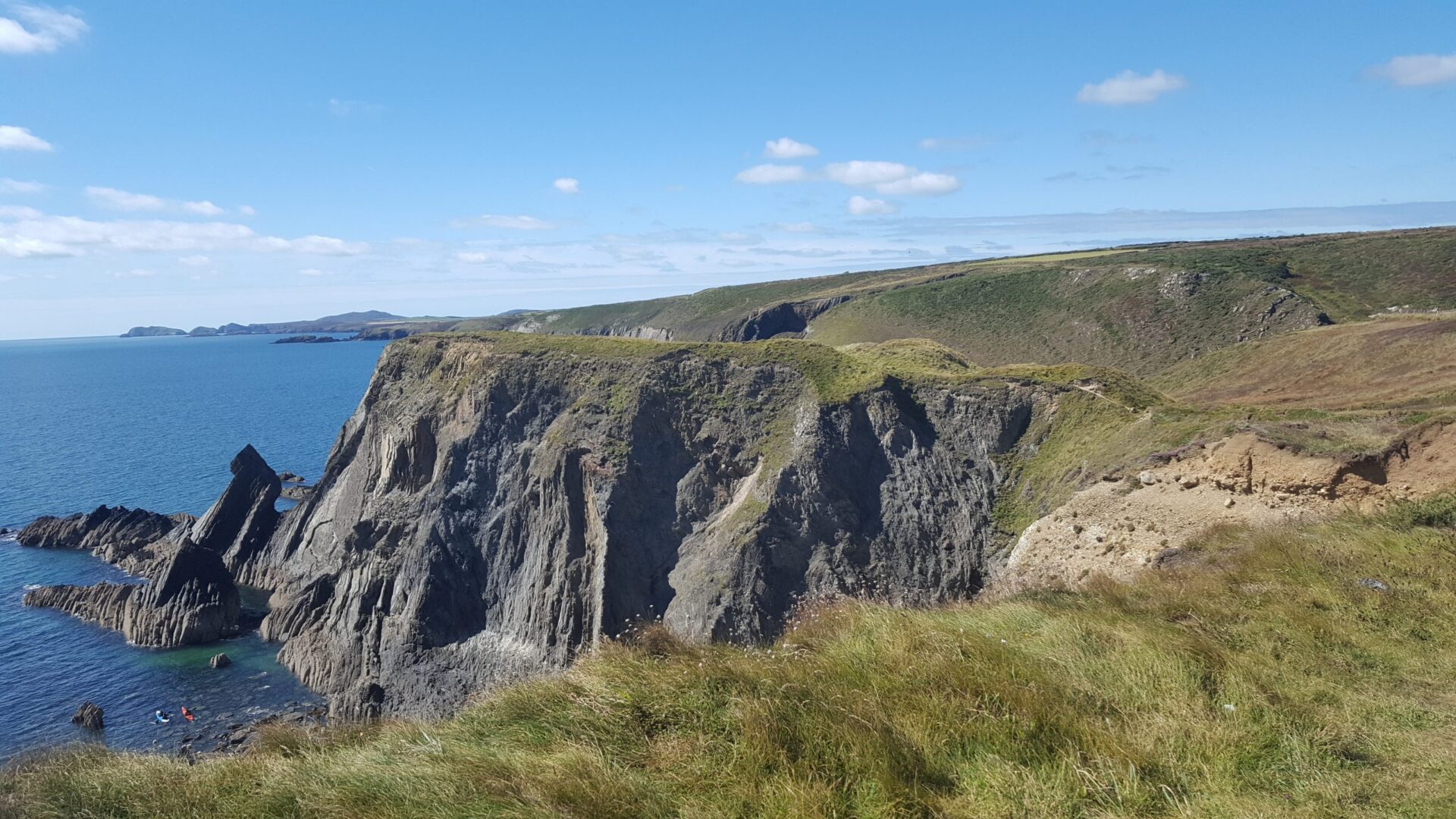
Along Pembrokeshire’s wild coastline, the same forces that shape its beauty are reshaping its history. Wind, tide and sea carve new stories into the cliffs, uncovering ancient chapels, forts and settlements while others slip quietly away. Every storm reveals something lost, something hidden, something new. This is a coastline in constant conversation with time, where discovery and disappearance go hand in hand.
Erosion and exposure
Pembrokeshire’s coastline is one of constant change, where each winter storm reshapes the edges of history.
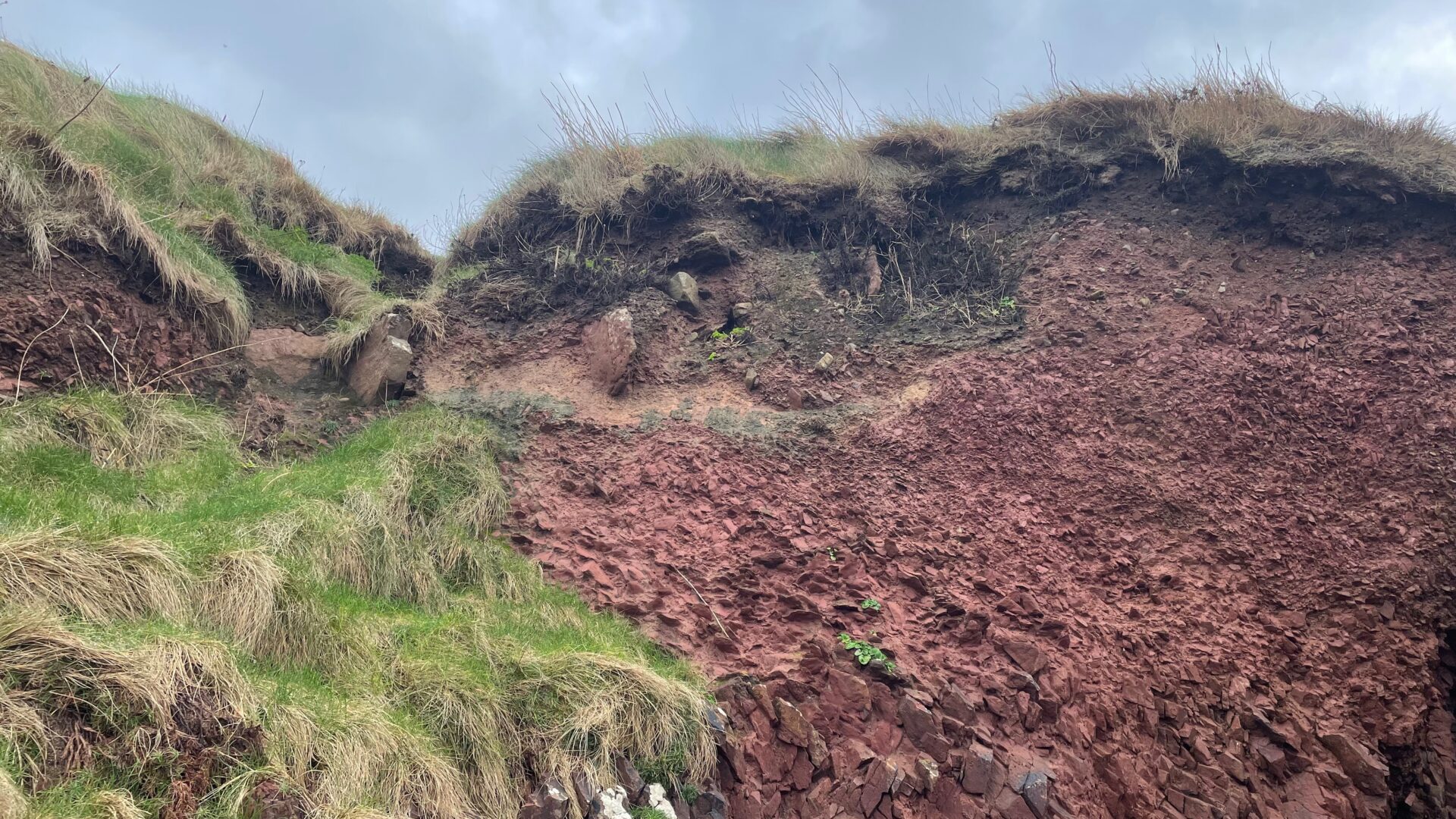
Nowhere is this more evident than at St Patrick’s Chapel above Whitesands Bay, an early Christian site dating back to the 6th century. Coastal erosion has destabilised the ground and exposed stone-lined graves, some still containing well-preserved skeletal remains. Emergency excavations have revealed centuries of activity, offering rare glimpses into early medieval life.

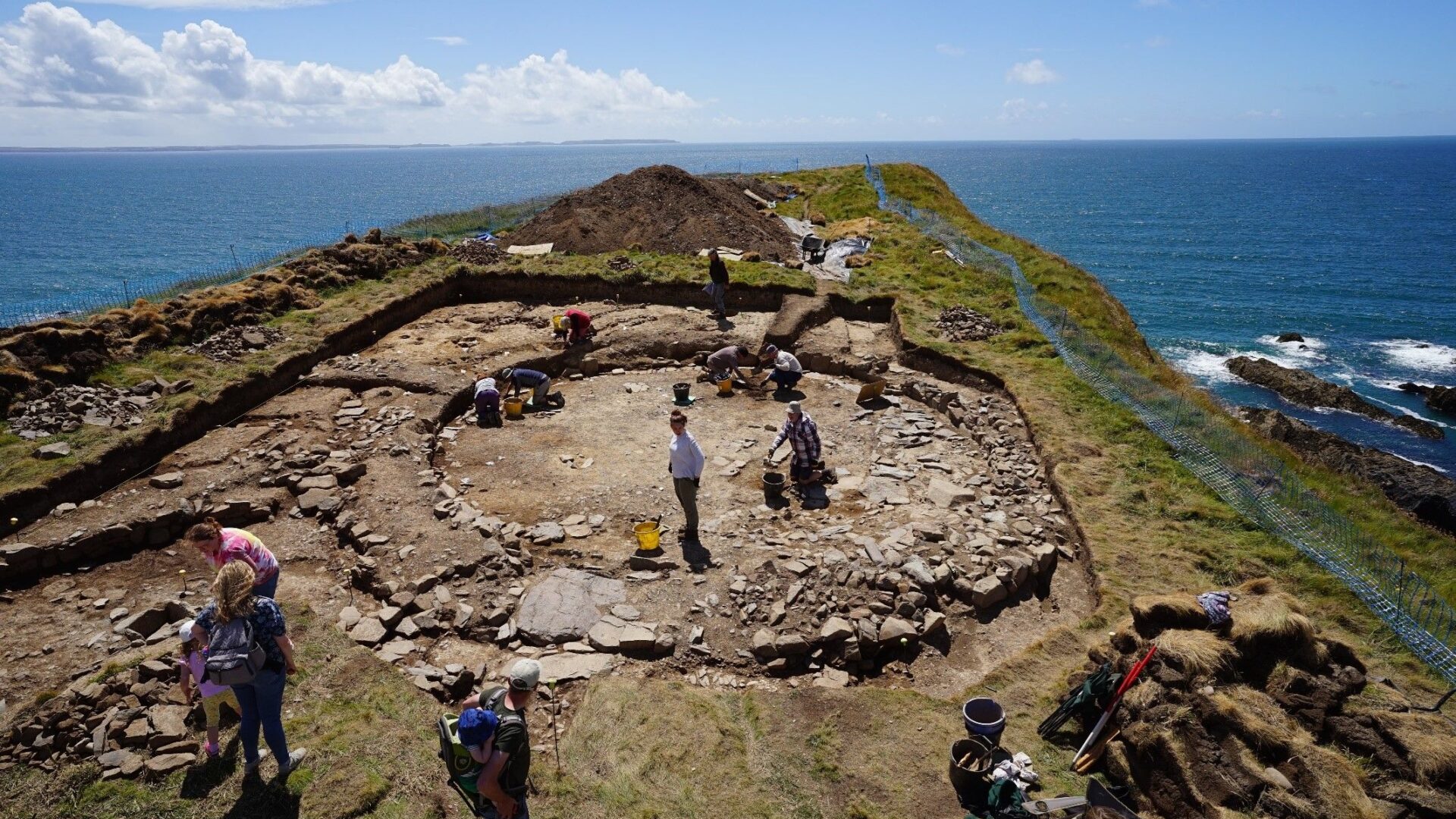
Further south near Solva, the Iron Age promontory fort at Porth y Rhaw clings to a narrow headland above St Brides Bay. Once protected by cliffs and earthworks, much of it has already been claimed by the sea. Archaeologists have uncovered roundhouse foundations, pottery and tools that hint at the lives of its inhabitants, but each storm takes a little more away.
Together, these places show both sides of coastal change – destruction and revelation, loss and discovery written into the same landscape.
Seeing the unseen
Not every discovery comes from the sea. Some are found from the sky. Across North Pembrokeshire, archaeologists are using LiDAR and high-resolution aerial photography to uncover traces of the past long hidden beneath woodland and scrub. Flying low over Strumble Head, aircraft scan the ground with lasers, producing 3D models that reveal subtle ridges, ditches and embankments – the ghost outlines of ancient field systems, hillforts and settlements invisible from the ground.
These surveys are transforming how the National Park’s heritage is recorded and protected. Each scan captures not just what exists now, but what may soon be lost. Volunteers help interpret the data and verify new finds, combining digital technology with local knowledge to map a landscape that is both ancient and ever-changing.
Inspiring the next generation
While technology helps uncover what the landscape hides, another strand of work is giving young people the chance to tell those stories themselves. The project Tough Decisions: Communicating Climate Risk and Heritage Loss, delivered with the Museum of London Archaeology (MOLA), brought together learners aged 16 – 20 to explore how rising seas are reshaping the coastline.
They visited sites including Caerfai, St Brides and West Angle, using drones and video to create short bilingual films that capture both the threat to Pembrokeshire’s heritage and their connection to place. Their work, to be shown at Archaeology Day 2025, shares the voices of a new generation who have seen first-hand what is at stake – and how the stories of the past can inspire action today.

Shaped by time and tide
From the exposed graves at St Patrick’s Chapel to the LiDAR traces of forgotten forts, Pembrokeshire’s coastline continues to reveal how people have lived and built along its shifting edge. Each new discovery, whether unearthed by erosion, mapped from the air or filmed by young storytellers, deepens our understanding of a landscape that never stands still.
This is a coast that rewrites its own history with every tide. What we find here is never just the past – it’s the story of our connection to it, still unfolding with the sea.
It’s not every day you get to see one of our National Parks in biscuit form on @britishbakeoff!
Last night, The Great British Bake Off contestant @itsdoctoryan created a beautiful biscuit mosaic inspired by the Broads National Park, perfectly capturing the view at St Benet’s Mill, Thurne.
And it wasn’t just a feast for the eyes as the mosaic was made using treacle and ginger, honey and lemon, cocoa and malted milk, and pistachio biscuits.
Two great things combined: a beautiful National Park view and delicious biscuits. What could be better than that? 💚
Photo: Channel 4
#GBBO #BakeOff #NorfolkBroads @broadsnationalpark


You’ve likely heard of one - but what does it actually do?
Our 15 Parks wouldn’t be able to function without the authorities working behind the scenes to keep them running.
And each authority relies on people. People within the community, volunteers, staff and members. People that run businesses, or partner as organisations. People that are skilled and knowledgeable in a variety of areas from wildlife to accessibility.
Our National Parks are full of people and action, and it’s the Authorities that bring them all together.
💚
#NationalParksUK #NationalParkAuthorities

The Yorkshire Dales has one of the highest concentrations of caves and caverns of any of our 15 National Parks - a whole landscape hiding beneath the ground.
Our National Parks don’t just protect and preserve the landscapes we see every day. They also help care for historic and unique places discovered by our ancestors, like Ingleborough Cave and Gaping Gill, both of which were shrouded in myth and legend until they were explored by Victorians in the 1800s.
There’s so much more to our National Parks than meets the eye and sometimes, quite literally beneath the surface 👀
#YorkshireDales #GapingGill #Ingleborough

A week on from National Parks UK’s Big Volunteer Weekend, we’re still celebrating the people who make a difference across our National Parks.
Last weekend, hundreds of people came together across all 15 National Parks to give their time, share their skills and support our landscapes.
But volunteering in our National Parks doesn’t happen just one weekend a year. All year round, volunteers play an incredible variety of roles – from leading guided walks and supporting education, to conservation, planting and caring for our landscapes.
Every volunteer makes a valuable contribution to protecting our natural and cultural heritage. We simply couldn’t do what we do without you. 💚
So, to all our volunteers: thank you for your time, energy, enthusiasm and everything you bring to our National Parks.
If you know someone who volunteers in a National Park, help us spread the thanks by sharing this post. 🌿
#Volunteers #NationalParks #NationalParksUK

Mae’r Bele yn un o famaliaid prinnaf Cymru, ond mae eu niferoedd yn tyfu yn raddol. Mae hynny’n newyddion da i’n coetiroedd ac i’r Parciau Cenedlaethol, sy’n darparu rhai o’r cynefinoedd pwysicaf ar gyfer bywyd gwyllt ledled Cymru a Phrydain.
Ym Mannau Brycheiniog, mae’r prosiect adfer wedi gosod blychau nythu yn y coed, ac mae gwaith monitro wedi nodi presenoldeb y Bele, gan gynnwys grwpiau teuluol. Mae’r ffilm arbennig hon yn dangos un ohonynt ar waith. 🐾
Mae’n atgof hyfryd o’r hyn sy’n bosibl pan ddaw coetiroedd iach a gwaith cadwraeth arbenigol at ei gilydd i roi’r gofod sydd ei angen ar rywogaethau prin i wella.
Pine Martens are one of Wales’ rarest mammals, but they’re slowly making a comeback. That’s good news for our woodlands, and for National Parks, which provide some of the most important habitats for wildlife across Wales and Britain.
In Bannau Brycheiniog (the Brecon Beacons), the recovery project has installed treetop den boxes, with monitoring identifying pine martens, including family groups. This special footage shows one in action. 🐾
It’s a lovely reminder of what can happen when healthy woodlands and specialist conservation work come together to give rare species the space they need to recover.
#BreconBeacons #BannauBrycheiniog #PineMartins #Wales

It’s the Autumn Equinox 🍂
Our National Parks are always changing in time with the rhythm of nature, but this becomes particularly noticeable when autumn arrives.
Deer begin to rut, spiders’ cobwebs glisten in the fresh light, fungi become more prominent, and leaves begin to change colour.
What changes have you noticed so far? 🧡
#Autumn #AutumnEquinox #NationalParks

“You look after the National Park not for yourself, but for people who are coming, the ones who are following you.”
These are the words of Ron Wood, who has been volunteering for the Lake District National Park for over 60 years. His story reflects the vital role volunteering plays across our National Parks: keeping them thriving, communities invested, and people connected to and caring for our landscapes.
Over the decades, Ron’s incredible journey has seen him remain steadfast in his commitment through droughts, hand, foot and mouth disease, and the ever-changing rhythms of nature. Through it all, one thing has remained constant: his dedication to looking after the environment for those who come after him.
You can read Ron`s full story by clicking the link in our bio or learn more about volunteering at nationalparks.uk/volunteering 🔗
📸Photos by @lakedistrictnpa
#LakeDistrict #Volunteering #NationalParks

A quiet autumn transformation is beginning to take place. 🍁
Bracken gradually fades to burnt oranges. Mist sweeps across the horizon. Grasses brown and trees begin their annual shaking of leaves.
Our National Parks are never still. They are constantly changing and transforming with the seasons - a living rhythm of growth, decay, colour and renewal.
These four photographs perfectly capture our Parks on the cusp of autumn 📸
1. Dartmoor @ryanbrowningphotography
2. Lake District @jonny.gios
3. New Forest @acornsandscapes
4. Northumberland @calbrownphoto
#Autumn #NationalParksUK
